
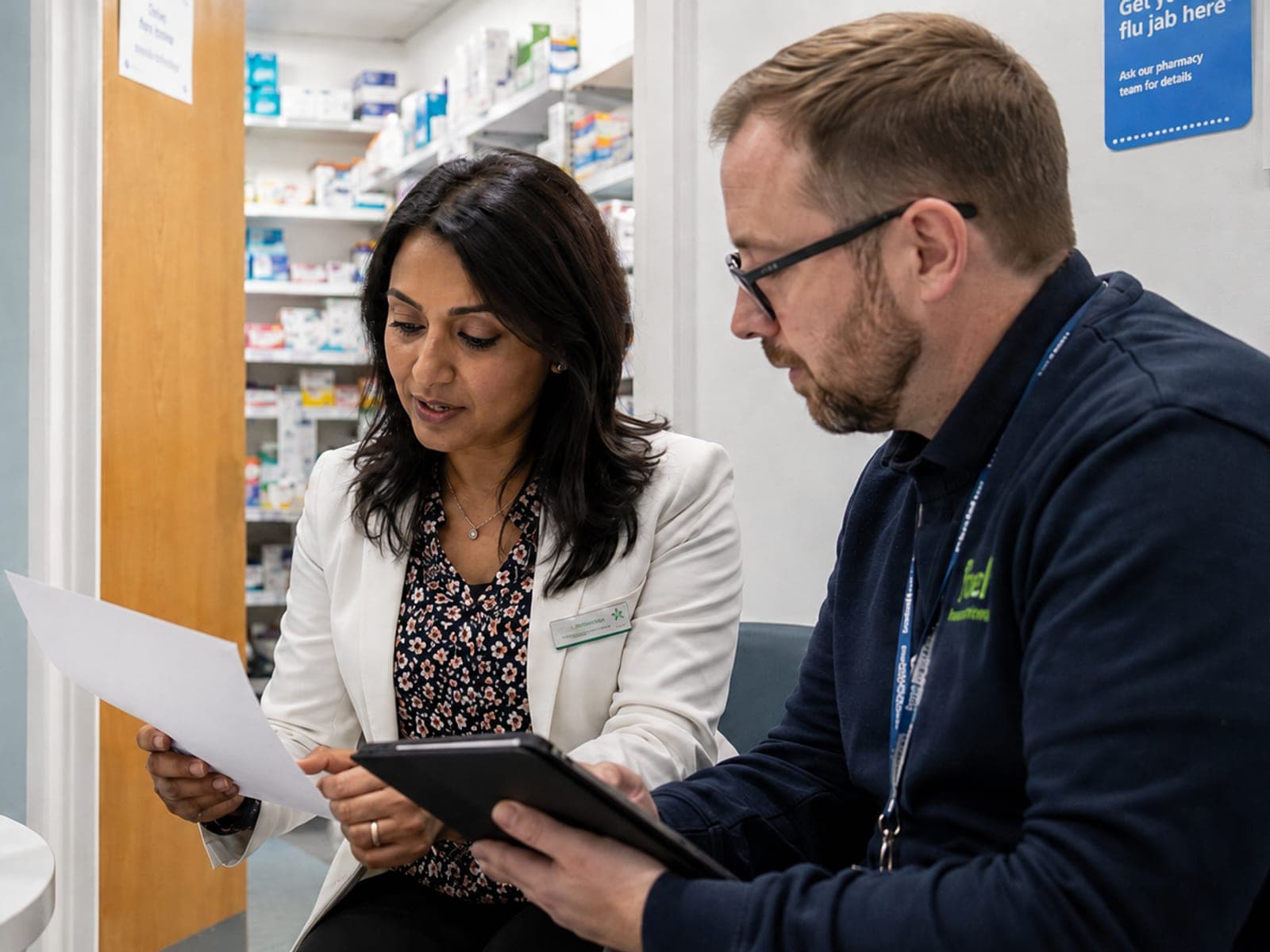
On 29 May 2026 the government and Community Pharmacy England agreed a new deal for pharmacy in England — the 2026/27 Community Pharmacy Contractual Framework. It brings a 10.3% funding rise, a higher dispensing fee, and a new national NHS prescribing offer. It also changes very little about the day-to-day squeeze. Here is what it actually means for you.
Note
In short: total funding rises to £3.636 billion, up £340 million (10.3%) on last year. Almost all of that went into the dispensing fee — now £1.52 an item — plus a bigger medicines margin and a write-off of past over-earnings. Most service fees, including the Pharmacy First consultation fee, were held at last year's level. The structural change is a national NHS independent prescribing service from autumn 2026. Even so, funding is still well below where it was in 2015 in real terms — which is why CPE called accepting the deal a "very difficult decision" and is still pushing for wider reform.
This is England only. Scotland, Wales and Northern Ireland run their own contracts, with different funding, fees and services — none of the figures below apply to them.
What actually changed#
The number doing the rounds is £3.636 billion — the total the contract is worth for 2026/27. That is up £340 million, or 10.3%, on the 2025/26 baseline of £3.296 billion (DHSC, GOV.UK). The government calls it one of the largest budget uplifts across the NHS this year — though it is a step down from last year's exceptional 19.7% jump, and it follows years of real-terms decline.
Two things matter before you get excited about a double-digit percentage:
- That total already includes the medicines margin (£1.1 billion of it). It is not £3.636 billion plus margin.
- A global sum is not guaranteed income. It is the size of the pot the whole sector draws from through dispensing volume and services — not a cheque that lands on any one pharmacy's desk.
The more revealing question is where the extra money went. The answer: overwhelmingly into the dispensing fee, with almost everything else frozen.
Where the money actually went#
| Item | 2025/26 | 2026/27 |
|---|---|---|
| Total CPCF funding | £3.296bn | £3.636bn |
| Year-on-year change | — | +£340m (+10.3%) |
| Single Activity Fee (per item) | £1.46 | £1.52 (+6p) |
| Retained medicines margin | £900m | £1.1bn (+£200m) |
| Pharmacy First fee (per consultation) | £17 | £17 (held) |
| Pharmacy First monthly payment | £500 or £1,000 | £500 or £1,000 (held) |
The Single Activity Fee — the flat fee paid on essentially every dispensed item — rises from £1.46 to £1.52. That is 6p an item, a 4.1% increase, backdated to May 2026 (DHSC; Community Pharmacy England). Six pence sounds trivial until you multiply it by volume:
- A pharmacy dispensing 8,000 items a month earns an extra £480 a month from the uplift — roughly £5,760 a year.
- A busier branch on 12,000 items gains about £720 a month, or £8,640 a year.
(Those are illustrative — your branch's real figure depends on its own dispensing volume.) This is deliberate: CPE said the settlement prioritised the SAF because it flows to every contractor on the work they already do, and it explicitly came at the cost of uplifts elsewhere — all other service fees were maintained at 2025/26 levels.
The retained medicines margin rises by £200 million to £1.1 billion. Margin is the money pharmacies are allowed to keep on the gap between what they pay for stock and the reimbursement price set in the Drug Tariff — a real, if lumpy, part of the bottom line. A bigger allowance means less of it is clawed back.
Past over-earnings are being written off, too — up to £239 million of margin that pharmacies over-delivered against previous targets. Read that carefully: it is a cancellation of a future clawback, not new cash in the till. It stops money leaving; it does not add money in. It is also separate from the £193 million written off in last year's deal — two different one-off reconciliations that are easy to muddle.
Pharmacy First: the fee was frozen#
Here is the bit that catches people out. The Pharmacy First consultation fee is £17 — but it did not go up this year. The rise from £15 to £17 happened back in April 2025; for 2026/27 it was simply held (DHSC). If you see a headline implying the new contract raised it, that is wrong.
The payment structure is unchanged, and it has a threshold worth understanding:
- You earn the £17 item-of-service fee for each completed consultation, plus
- A monthly fixed payment that is banded by volume: £500 for 20–29 consultations in the month, and £1,000 for 30 or more. There is no fixed-payment band below 20 consultations.
So a month with 30 consultations earns roughly £1,000 + (30 × £17) = £1,510. Slip below the 20-consultation floor and the fixed payment falls away — a quiet month of 18 consultations leaves you on the 18 × £17 = £306 in consultation fees alone. To earn the monthly payment you also have to be signed up to the Hypertension Case-Finding and Pharmacy Contraception services.
For a pharmacist working the floor, the practical read is simple: Pharmacy First volume is now a fixed feature of the job, and the incentives push branches hard to clear the monthly thresholds. Expect it to shape how shifts are staffed and how much of your day is clinical rather than dispensing.
The other clinical services: frozen fees, tighter caps#
Pharmacy First isn't the only service that stood still. To fund the dispensing-fee rise, the deal held every other service fee at its 2025/26 level — and on two of them it also tightened the cap on how much activity you can actually be paid for.
| Service | Fee (held from 2025/26) | What changed for 2026/27 |
|---|---|---|
| New Medicine Service (NMS) | £28 per completed NMS (£14 each for the intervention and the follow-up) | Fee held — but the monthly cap on claimable NMS is cut from 1.0% to 0.9% of your prescription items, from June 2026 |
| Hypertension Case-Finding (blood pressure) | £10 per clinic blood-pressure check, £50.85 per ambulatory (ABPM) reading | Fees held — new activity caps flagged, with the detail to be agreed during the year |
| Pharmacy Contraception Service | £25 per initiation or ongoing consultation, £20 for emergency contraception | Fees held |
Two things to take from that:
- A frozen fee is a real-terms cut. With inflation still running, £28 for an NMS or £50.85 for an ABPM buys less than it did a year ago — the same money for the same work, worth a little less each month.
- The NMS cap change is small but telling. Trimming the claimable ceiling from 1.0% to 0.9% of your items reduces what a busy pharmacy can earn on NMS — and CPE was explicit that the money saved is "redirected back into the contract sum" to help fund the dispensing-fee uplift (Community Pharmacy England). Put plainly: part of your 6p-an-item rise was paid for by tightening what you can claim on the New Medicine Service.
The real change: NHS independent prescribing#
The structural headline isn't a fee — it's a service. From autumn 2026 (CPE expects around October), there is a national NHS independent prescribing offer, funded with a £500 one-off set-up payment and a £525-a-month infrastructure payment per pharmacy (Community Pharmacy England). It starts inside Pharmacy First and the contraception service, with more prescribing pathways expected to follow over time.
The detailed specification is still being finalised as I write this, so treat the timing and scope as coming, not live. But the direction is unmistakable, and for individual pharmacists it is the most important line in the whole document. From 2026, pharmacists who trained under the reformed standards join the register as independent prescribers from the start, and this is the contract starting to build the paid NHS infrastructure for them to use it. If you prescribe, you are about to become materially more valuable to a pharmacy — as an employee and, increasingly, as a locum.
What it means for you, in real terms#
The contract funds contractors, not individual pay packets. But funding sets the weather for everyone's work, so here is the honest read for each group.
If you're a locum#
The CPCF does not set your rate — but it shapes the environment that does. The brutal rate cuts of 2023–24 tracked the sector's cash crisis; a higher dispensing fee and £200 million more margin ease that pressure a little, which is mildly supportive of rates. Don't expect a boom — the underlying funding is still tight — but the floor feels a bit steadier than it did.
Two things will change your shifts more than your rate: Pharmacy First will fill more of your day, and prescribing is becoming a paid, in-demand skill. An IP-qualified locum who can run clinical pathways is exactly what the 2026/27 contract is built to reward. If you've been sitting on the fence about the prescribing qualification, this is the nudge.
If you're an employed pharmacist#
The uplift is a point in favour of job security — a sector with more cash closes fewer doors. But with most service fees frozen and funding still below the cost of providing the service, the pressure on staffing, hours and pay doesn't lift. The genuine opportunity here is upskilling: the independent prescribing offer is your employer's incentive to fund and roster you into clinical work, which is where both the money and the career are heading.
If you own or run a pharmacy#
You are the direct beneficiary — and the one who already knows the money is tight. The SAF rise and the bigger margin help cash flow; the write-off stops a painful clawback. But CPE, the Company Chemists' Association and the sector's own economic analysis all say the same thing: the deal does not close the gap between funding and the cost of delivering NHS services. Plan on the uplift steadying the ship, not turning it around.
The elephant in the room: real-terms funding#
A 10.3% cash rise is real, and it's genuinely welcome. But it lands on a decade of decline.
In real terms — adjusting for inflation — the 2025/26 core contract sum of £3.073 billion was around £800 million lower than the 2015/16 funding of £3.864 billion in today's prices. That's roughly a fifth less, confirmed in a parliamentary written answer. The sector's own independent economic review put the 2023/24 full economic cost of providing NHS pharmaceutical services at £5.06 billion against £2.76 billion of funding — a £2.3 billion shortfall, with nearly half of branches loss-making at the operating level. And the network keeps shrinking: 10,526 pharmacies were open in February 2026, against 11,609 ten years earlier — 1,083 fewer (House of Commons Library).
That context is exactly why Community Pharmacy England, whose chief executive is Janet Morrison, called accepting the deal a "very difficult decision" — and, even after signing, has kept pressing the government for the wider funding reform the sector says it still needs.
The bottom line#
The 2026/27 contract is a genuine step up — more cash, a higher dispensing fee, relief on clawbacks, and the beginnings of a paid NHS prescribing role. For a pharmacist at the bench, the two things to actually do something about are clear: Pharmacy First is now a core, target-driven part of the job, and independent prescribing is the skill the contract is quietly built to reward. But it is a step up from a low base, not a fix — the money still doesn't meet the cost of the work, and everyone who signed it said so.
Pharmosphere tracks the NHS dispensing and services data behind these numbers for every pharmacy in the country, and helps locums log shifts, invoice and estimate their tax as the clinical side of the job keeps growing. Know the numbers before you take the shift.
Sources#
Every figure below is dated to its contract year and traced to an official source — the government's own contract publications, Community Pharmacy England, Parliament and the House of Commons Library:
- Department of Health & Social Care — Community Pharmacy Contractual Framework: financial year 2026 to 2027 (published 29 May 2026)
- Community Pharmacy England — CPE secures 10% funding rise but pushes for reform, the 2026/27 settlement FAQs, and NMS: change to the monthly cap from June 2026
- DHSC — Community Pharmacy Contractual Framework: 2024 to 2025 and 2025 to 2026 (the prior settlement)
- Community Pharmacy England — Independent Economic Review of NHS community pharmacy
- House of Commons Library — Community pharmacy in England (briefing CBP-9854)
- UK Parliament — written question 113242 on real-terms pharmacy funding
General information for UK pharmacists, not financial or business advice. Figures are for England and correct at the time of writing; always check the primary source for the current position.
Comments
Join the conversation — sign in to comment.
Loading comments…